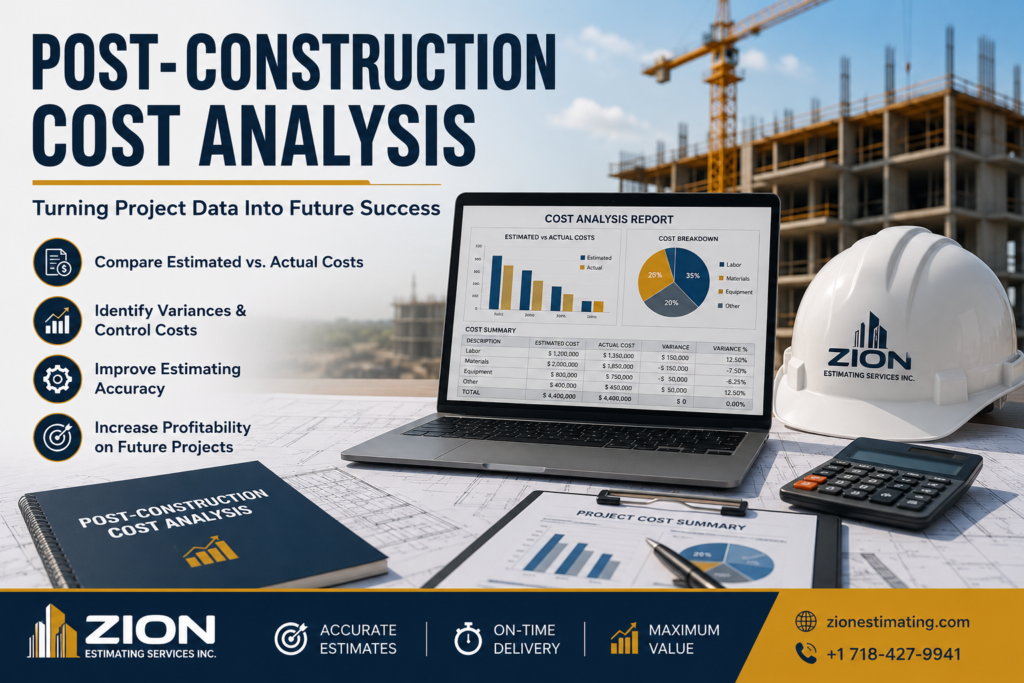
Post-Construction Cost Analysis: A Complete Guide to Improving Future Construction Projects
Company: Zion Estimating Services Inc.
Discover how post-construction cost analysis helps contractors, developers, and owners improve project profitability, estimate accuracy, budgeting, and future planning. Learn from Zion Estimating Services Inc.
Post-Construction Cost Analysis: The Key to Smarter and More Profitable Construction Projects


Every successful construction project provides more than just a completed building—it also provides valuable financial data that can improve future projects. While most contractors focus heavily on pre-construction estimating and project execution, many overlook one of the most valuable stages of the project lifecycle: post-construction cost analysis.
At Zion Estimating Services Inc., we believe that every completed project offers lessons that help contractors bid more accurately, improve profitability, reduce waste, and strengthen future estimating practices. A comprehensive post-construction cost analysis transforms historical project data into actionable business intelligence.
Whether you’re a general contractor, subcontractor, developer, architect, or project owner, understanding how your project performed financially is essential for long-term success.
What Is Post-Construction Cost Analysis?
Post-construction cost analysis is the systematic review and comparison of a project’s estimated costs against its actual costs after project completion.
The analysis identifies:
- Budget variances
- Labor productivity
- Material consumption
- Equipment expenses
- Change orders
- Schedule impacts
- Subcontractor performance
- Profit margins
- Unexpected costs
- Cost-saving opportunities
Rather than simply determining whether a project was profitable, post-construction cost analysis explains why it achieved—or missed—its financial goals.
Why Is Post-Construction Cost Analysis Important?
Many construction companies move directly from one project to the next without carefully reviewing completed work. This often results in repeating the same estimating mistakes and losing opportunities for improvement.
A detailed analysis helps businesses:
- Improve future cost estimates
- Increase bid accuracy
- Reduce financial risk
- Identify hidden expenses
- Enhance project planning
- Improve procurement strategies
- Increase profitability
- Build stronger estimating databases
- Improve resource allocation
- Strengthen decision-making
Companies that consistently review completed projects often produce more competitive bids while maintaining healthy profit margins.
Key Components of Post-Construction Cost Analysis
1. Estimated Cost vs Actual Cost
This is the foundation of every cost analysis.
The estimator compares:
- Original estimate
- Approved budget
- Final project cost
- Total profit
The comparison identifies:
- Overruns
- Savings
- Budget accuracy
- Estimating performance
2. Labor Cost Analysis
Labor often represents one of the largest construction expenses.
Review includes:
- Actual labor hours
- Productivity rates
- Overtime costs
- Crew efficiency
- Labor burden
- Trade-by-trade performance
Questions include:
- Were crews productive?
- Did labor exceed estimates?
- Which activities required more hours?
3. Material Cost Analysis
Material prices frequently fluctuate during construction.
Analysis includes:
- Purchased quantities
- Material waste
- Supplier pricing
- Delivery costs
- Storage costs
- Price escalations
The goal is to identify purchasing improvements for future projects.
4. Equipment Cost Evaluation
Equipment costs include:
- Rentals
- Fuel
- Maintenance
- Repairs
- Idle equipment
- Transportation
Understanding equipment utilization helps reduce unnecessary expenses.
5. Subcontractor Performance
Subcontractor analysis includes:
- Original contract values
- Change orders
- Schedule compliance
- Quality performance
- Cost overruns
Reliable subcontractors often reduce long-term project costs.
6. Change Order Analysis
Nearly every project experiences changes.
Review includes:
- Owner-requested changes
- Design revisions
- Scope increases
- Unexpected site conditions
The analysis determines whether change orders were properly priced and documented.
7. Schedule Performance
Time directly impacts project costs.
Schedule analysis examines:
- Delays
- Weather impacts
- Material shortages
- Labor availability
- Productivity losses
Longer schedules generally increase overhead expenses.
Common Reasons for Cost Overruns
Many completed projects reveal recurring issues such as:
- Incomplete drawings
- Design changes
- Material price increases
- Labor shortages
- Poor planning
- Weather delays
- Equipment breakdowns
- Inefficient scheduling
- Inaccurate quantity takeoffs
- Scope creep
Recognizing these causes helps organizations improve future estimates and project management practices.
Financial Metrics to Measure
A comprehensive post-construction review should evaluate:
- Final project cost
- Gross profit
- Net profit
- Cost variance
- Schedule variance
- Labor productivity
- Material variance
- Equipment utilization
- Cost per square foot
- Profit percentage
Tracking these metrics across multiple projects builds valuable historical benchmarks.
Benefits for Contractors
General contractors gain several advantages:
- More accurate bidding
- Better subcontractor selection
- Improved scheduling
- Higher profit margins
- Better resource planning
- Reduced project risk
- Stronger client relationships
- Improved forecasting
Benefits for Developers
Developers benefit through:
- Improved investment planning
- Better budgeting
- Increased ROI
- Better contractor evaluation
- More informed future developments
- Improved financing decisions
Benefits for Project Owners
Owners gain:
- Greater financial transparency
- Better accountability
- Improved value engineering
- Reduced lifecycle costs
- Better planning for future projects
The Role of Historical Cost Data
Historical project data becomes increasingly valuable over time.
Maintaining detailed records allows estimators to:
- Benchmark similar projects
- Forecast future budgets
- Validate unit prices
- Improve productivity assumptions
- Identify recurring risks
Reliable historical data leads to more dependable estimates and stronger financial planning.
Technology and Cost Analysis
Modern construction software simplifies post-construction reviews through:
- Digital cost tracking
- Cloud-based reporting
- Real-time dashboards
- Automated variance reports
- Historical cost databases
- Productivity tracking
- Budget forecasting
Combining software tools with expert analysis delivers deeper insights and more accurate forecasting.
Best Practices for Effective Post-Construction Cost Analysis
To maximize value:
- Collect accurate project data throughout construction.
- Compare estimated and actual costs promptly after project completion.
- Categorize expenses by CSI division or work package.
- Review labor productivity and equipment utilization.
- Analyze all approved change orders.
- Document lessons learned.
- Update estimating databases with verified historical costs.
- Share findings with estimating and project management teams.
- Monitor recurring trends across multiple projects.
- Continuously refine estimating methods based on real-world outcomes.
Common Mistakes to Avoid
Avoid these pitfalls:
- Ignoring indirect costs
- Failing to document change orders
- Using incomplete project data
- Overlooking labor productivity
- Not updating estimating databases
- Delaying project reviews
- Focusing only on total cost instead of cost categories
- Neglecting supplier performance
- Ignoring schedule impacts on cost
How Zion Estimating Services Inc. Helps
At Zion Estimating Services Inc., we help construction professionals make informed decisions through comprehensive estimating and cost analysis services.
Our expertise includes:
- Construction Cost Estimating
- Quantity Takeoffs
- Material Takeoffs
- Labor Cost Estimation
- Budget Planning
- Bid Preparation
- Value Engineering
- Cost Control Support
- Project Cost Analysis
- Historical Cost Benchmarking
- Residential Estimating
- Commercial Estimating
- Industrial Estimating
Our team works with contractors, developers, architects, engineers, and project owners throughout the United States and Canada, providing reliable estimates that support profitable project delivery.
Why Continuous Cost Analysis Matters
The construction industry is constantly evolving due to fluctuations in material prices, labor availability, and project complexity. Companies that routinely analyze completed projects are better positioned to adapt, refine their estimating methods, and maintain a competitive edge.
Continuous cost analysis enables organizations to:
- Develop more accurate bids.
- Reduce unexpected expenses.
- Improve operational efficiency.
- Strengthen client confidence.
- Increase long-term profitability.
Conclusion
Post-construction cost analysis is not merely a financial exercise—it is a strategic investment in future success. By comparing estimated costs with actual outcomes, evaluating labor and material performance, reviewing change orders, and documenting lessons learned, construction professionals can continuously improve the quality and accuracy of their estimates.
Organizations that embrace this process gain valuable insights that enhance budgeting, bidding, project management, and overall business performance. Whether you manage residential developments, commercial buildings, industrial facilities, or infrastructure projects, integrating post-construction cost analysis into your workflow is essential for sustainable growth.
At Zion Estimating Services Inc., we are committed to helping contractors, developers, and owners transform project data into better decisions. Our experienced estimating team provides accurate cost estimating, quantity takeoffs, budget analysis, and post-project evaluations that support more profitable and predictable construction outcomes.
If you’re ready to improve estimate accuracy, reduce financial risk, and maximize the value of every completed project, Zion Estimating Services Inc. is here to help. Contact us today to learn how our professional estimating and cost analysis services can support your next construction project.
📞 Contact us today for professional construction estimating services.
📧 [email protected]
📱 +1 718-427-9941
🌐 zionestimating.com