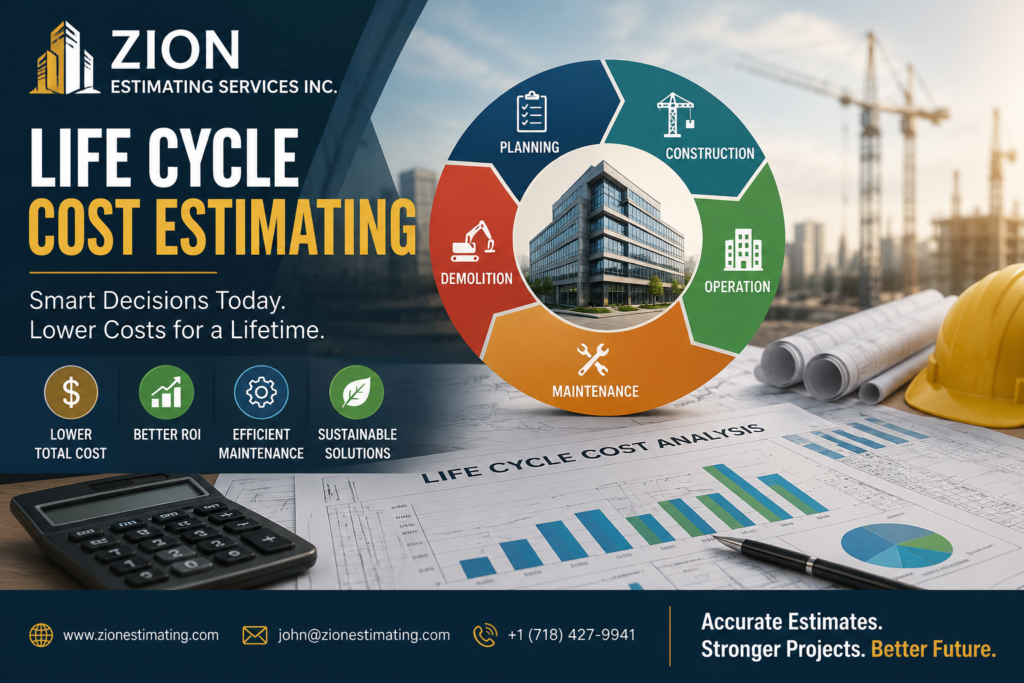
Learn how Life Cycle Cost Estimating helps contractors, developers, architects, and property owners reduce long-term building costs. Zion Estimating Services Inc. provides professional Life Cycle Cost Estimating services across the USA and Canada.
Life Cycle Cost Estimating: The Smart Way to Reduce Construction Costs Over a Building’s Lifetime


Introduction
Every construction project begins with one important question:
“How much will this building cost?”
Unfortunately, many owners only focus on the initial construction budget. While minimizing upfront expenses is important, it doesn’t provide the complete financial picture. Buildings continue to generate expenses throughout their entire lifespan—from maintenance and repairs to utility bills, renovations, equipment replacements, and eventual demolition.
This is where Life Cycle Cost Estimating (LCCE) becomes invaluable.
At Zion Estimating Services Inc., we help contractors, architects, developers, investors, facility managers, and property owners understand the true cost of owning a building over its entire life cycle, not just the construction phase.
Life Cycle Cost Estimating enables informed decisions that improve profitability, reduce operating expenses, and maximize long-term return on investment.
What is Life Cycle Cost Estimating?
Life Cycle Cost Estimating (LCCE) is the process of calculating the total cost of a building or infrastructure asset throughout its entire useful life.
Instead of focusing only on construction costs, LCCE evaluates every major expense the owner will incur, including:
- Initial construction
- Design costs
- Material costs
- Labor costs
- Equipment costs
- Energy consumption
- Maintenance
- Repairs
- Replacement of building systems
- Renovations
- Operational expenses
- Disposal or demolition costs
The goal is to identify the most cost-effective solution over the long term rather than simply selecting the lowest initial bid.
Why Life Cycle Cost Estimating Matters
Construction decisions made today affect building performance for decades.
For example:
A lower-cost HVAC system may save $30,000 during construction but consume hundreds of thousands of dollars in additional energy over the next 25 years.
Similarly, selecting premium roofing materials may increase initial costs while significantly reducing maintenance and replacement expenses.
Life Cycle Cost Estimating helps owners understand these trade-offs before construction begins.
Benefits include:
- Better investment decisions
- Reduced operating expenses
- Lower maintenance costs
- Increased asset value
- Improved sustainability
- Better budgeting
- Enhanced financial planning
- Reduced risk
Components of Life Cycle Cost Estimating


A complete Life Cycle Cost Estimate typically includes:
1. Initial Construction Costs
These are the costs associated with building the project.
Examples include:
- Site preparation
- Concrete
- Structural steel
- Masonry
- Drywall
- Roofing
- Mechanical systems
- Electrical systems
- Plumbing
- Interior finishes
- Labor
- Equipment
- Contractor overhead
2. Operating Costs
Operating costs occur throughout the building’s life.
These include:
- Electricity
- Water
- Gas
- Heating
- Cooling
- Security systems
- Cleaning
- Facility management
- Insurance
3. Maintenance Costs
Every building requires regular maintenance.
Examples include:
- Painting
- Flooring replacement
- Roof inspections
- HVAC servicing
- Plumbing repairs
- Window maintenance
- Elevator servicing
- Fire protection inspections
Routine maintenance extends building life and prevents expensive emergency repairs.
4. Replacement Costs
Some building components have shorter lifespans than the building itself.
Examples:
| Component | Typical Life |
|---|---|
| Carpet | 10–15 Years |
| Roof Membrane | 20–30 Years |
| HVAC Equipment | 15–25 Years |
| Boilers | 20–30 Years |
| Chillers | 20–30 Years |
| Lighting Fixtures | 10–20 Years |
Life Cycle Cost Estimating accounts for future replacement expenses.
5. End-of-Life Costs
Eventually, buildings require demolition or major redevelopment.
These costs include:
- Demolition
- Waste disposal
- Site restoration
- Environmental cleanup
- Material recycling
Life Cycle Cost Analysis (LCCA)
Life Cycle Cost Analysis compares multiple design alternatives to determine which option provides the greatest long-term value.
For example:
Option A
- Initial Cost: $500,000
- Maintenance Cost: High
- Energy Cost: High
Option B
- Initial Cost: $560,000
- Maintenance Cost: Low
- Energy Cost: Low
Although Option B costs more initially, it may save hundreds of thousands of dollars over 30 years.
Where Life Cycle Cost Estimating is Used
Life Cycle Cost Estimating is valuable in nearly every construction sector, including:
- Commercial Buildings
- Office Buildings
- Schools
- Universities
- Hospitals
- Hotels
- Warehouses
- Manufacturing Facilities
- Airports
- Government Buildings
- Residential Communities
- Shopping Centers
- Data Centers
- Industrial Plants
Factors Affecting Life Cycle Costs
Several factors influence long-term building costs:
Material Quality
Higher-quality materials generally require fewer repairs and replacements.
Energy Efficiency
Efficient insulation, lighting, and HVAC systems reduce utility expenses.
Building Location
Climate affects maintenance schedules, energy use, and material durability.
Occupancy
Buildings with higher occupancy often experience greater wear and tear.
Maintenance Strategy
Preventive maintenance is typically less expensive than reactive maintenance.
Technological Upgrades
Modern building technologies can improve efficiency and reduce long-term costs.
Benefits of Life Cycle Cost Estimating
Better Budget Planning
Owners can forecast future expenditures more accurately.
Improved Return on Investment
Selecting durable systems often results in greater long-term savings.
Reduced Operational Costs
Efficient building systems lower monthly expenses.
Enhanced Sustainability
Energy-efficient buildings reduce environmental impact while lowering operating costs.
Better Decision Making
Project teams can compare alternatives using objective financial data.
Increased Property Value
Buildings with lower operating costs are generally more attractive to buyers and investors.
Common Mistakes Without Life Cycle Cost Estimating
Many projects focus solely on the lowest construction bid.
This can result in:
- High maintenance costs
- Frequent repairs
- Increased energy consumption
- Shorter equipment life
- Poor return on investment
- Unexpected replacement costs
- Higher ownership expenses
Life Cycle Cost Estimating helps avoid these costly mistakes.
Sustainable Construction and Life Cycle Cost Estimating
Sustainability and cost efficiency often go hand in hand.
Life Cycle Cost Estimating supports green building practices by evaluating:
- Solar energy systems
- High-performance insulation
- LED lighting
- Smart building controls
- Water-saving fixtures
- Renewable energy technologies
- Recycled building materials
Although these solutions may require a higher initial investment, they often deliver significant savings throughout the building’s lifespan.
How Zion Estimating Services Inc. Supports Your Project
At Zion Estimating Services Inc., we provide detailed and reliable Life Cycle Cost Estimating services to help clients make informed financial decisions.
Our services include:
- Construction Cost Estimating
- Quantity Takeoffs
- Material Takeoffs
- Budget Estimating
- Conceptual Estimating
- Value Engineering Support
- Bid Estimates
- Commercial Estimating
- Residential Estimating
- Cost Analysis
- Long-Term Cost Planning
- Feasibility Cost Studies
Our experienced estimators work across all CSI divisions and utilize industry-standard estimating methods to deliver accurate and dependable results.
Who Can Benefit?
Our Life Cycle Cost Estimating services are ideal for:
- General Contractors
- Subcontractors
- Developers
- Architects
- Engineers
- Facility Managers
- Government Agencies
- Educational Institutions
- Healthcare Organizations
- Real Estate Investors
- Property Managers
Whether you are planning a new development, renovating an existing facility, or comparing design alternatives, Life Cycle Cost Estimating helps you make financially sound decisions.
Why Choose Zion Estimating Services Inc.?
Clients choose Zion Estimating Services Inc. because we are committed to delivering estimates that are accurate, timely, and practical.
Our advantages include:
- Experienced professional estimators
- Comprehensive quantity takeoffs
- Fast turnaround times
- Competitive pricing
- Residential and commercial expertise
- Coverage across the USA and Canada
- Detailed reporting
- Reliable customer support
Our mission is to help clients reduce risk, improve project planning, and achieve better financial outcomes throughout the entire life of their construction projects.
Conclusion
Life Cycle Cost Estimating is no longer optional for organizations seeking to maximize the value of their construction investments. By evaluating the total cost of ownership—from design and construction through operation, maintenance, replacement, and eventual demolition—owners can make smarter decisions that reduce long-term expenses and improve building performance.
Whether you’re constructing a new commercial building, renovating an existing facility, or planning future capital investments, Life Cycle Cost Estimating provides the insight needed to balance upfront costs with long-term savings.
At Zion Estimating Services Inc., we are dedicated to helping clients achieve cost-effective, sustainable, and financially successful projects through professional estimating and comprehensive life cycle cost analysis.
Contact Zion Estimating Services Inc.
Zion Estimating Services Inc.
Website: www.zionestimating.com
Email: [email protected]
Phone: +1 (718) 427-9941
Partner with Zion Estimating Services Inc. and make informed construction decisions that deliver value not only today—but for decades to come.