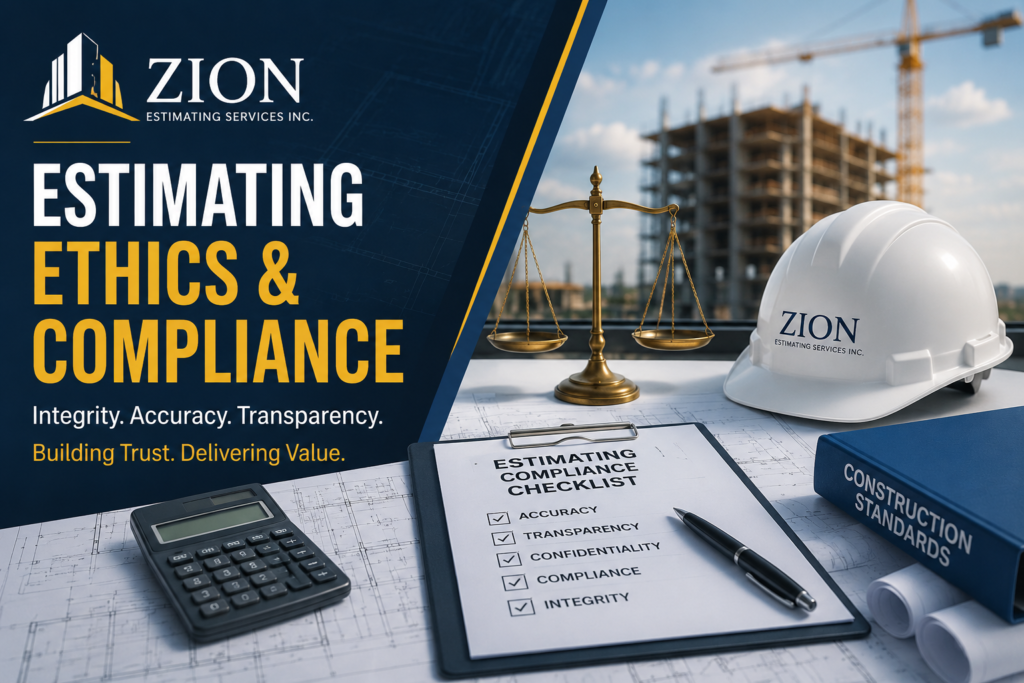
Learn why estimating ethics and compliance are essential in construction. Discover best practices for accurate cost estimating, transparent bidding, confidentiality, and professional standards with Zion Estimating Services Inc.
Estimating Ethics and Compliance: Building Trust Through Accurate and Transparent Construction Estimating


Introduction
In today’s highly competitive construction industry, success depends on far more than submitting the lowest bid. Contractors, developers, architects, and project owners all rely on accurate estimates that reflect the true scope and cost of a project. Behind every reliable estimate lies a foundation of ethics, transparency, and compliance.
At Zion Estimating Services Inc., we believe that ethical estimating practices are just as important as technical expertise. Every estimate should be prepared honestly, accurately, and professionally while complying with industry standards, contractual requirements, and applicable regulations.
Ethical estimating builds long-term relationships, protects contractors from financial losses, minimizes disputes, and strengthens the reputation of everyone involved in a construction project.
This article explores the importance of estimating ethics and compliance, industry best practices, and how ethical estimating contributes to successful project delivery.
What is Estimating Ethics?
Estimating ethics refers to the professional principles that guide estimators when preparing construction cost estimates.
These principles ensure that every estimate is:
- Honest
- Accurate
- Transparent
- Objective
- Confidential
- Free from conflicts of interest
Ethics require estimators to provide realistic project costs instead of manipulating numbers to satisfy unrealistic expectations.
Professional estimators understand that every estimate influences major business decisions including:
- Contractor bidding
- Project financing
- Owner budgeting
- Material procurement
- Scheduling
- Risk management
One inaccurate estimate can affect an entire construction project.
Understanding Compliance in Construction Estimating


Compliance means following all applicable:
- Contract requirements
- Building codes
- Industry standards
- Client specifications
- Procurement guidelines
- Company policies
- Local regulations
- Federal regulations (where applicable)
Construction estimators must carefully review project documents to ensure that pricing reflects every required specification.
Compliance also includes maintaining proper documentation to support every quantity takeoff and pricing decision.
Why Ethics Matter in Construction Estimating
Construction estimating is built on trust.
General contractors trust subcontractors.
Owners trust contractors.
Developers trust consultants.
Banks trust budgets.
Investors trust project forecasts.
If estimates are intentionally misleading, every stakeholder becomes exposed to unnecessary financial risk.
Ethical estimating helps create:
- Better client relationships
- Accurate project planning
- Higher bid credibility
- Improved profitability
- Reduced legal disputes
- Greater industry reputation
Core Ethical Principles Every Estimator Should Follow
1. Accuracy
Every estimate should reflect actual project requirements.
Estimators should never intentionally overestimate or underestimate costs.
Accurate quantity takeoffs are the foundation of every successful estimate.
2. Honesty
Clients deserve realistic budgets.
Artificially lowering estimates simply to win work often leads to:
- Budget overruns
- Change orders
- Client dissatisfaction
- Loss of trust
Honest estimates protect both contractors and owners.
3. Transparency
Professional estimates should clearly explain:
- Scope included
- Scope excluded
- Assumptions
- Clarifications
- Material allowances
- Labor assumptions
- Equipment pricing
Transparency prevents misunderstandings during construction.
4. Confidentiality
Estimators frequently work with confidential information including:
- Bid pricing
- Client budgets
- Vendor quotations
- Supplier discounts
- Proprietary designs
Professional ethics require protecting this information.
Sharing confidential pricing without authorization is unethical and may violate contractual obligations.
5. Objectivity
Estimators should base pricing on facts rather than personal opinions.
Costs should reflect:
- Market conditions
- Actual labor productivity
- Material pricing
- Equipment costs
- Project complexity
Personal bias should never influence an estimate.
6. Accountability
Professional estimators take responsibility for their work.
If errors are discovered, they should be corrected promptly and communicated honestly.
Common Ethical Challenges in Construction Estimating
Estimators often encounter situations that test professional integrity.
Examples include:
Unrealistically Low Bids
Some companies intentionally submit low bids expecting to recover profits through change orders later.
This practice damages client relationships and industry trust.
Bid Shopping
Bid shopping occurs when contractor pricing is shared with competitors after bid submission.
This practice is widely considered unethical.
Hidden Costs
Leaving out known project costs to make bids appear more competitive creates significant financial risks.
Hidden costs eventually become project disputes.
Inflated Quantities
Overstating quantities can increase project costs unnecessarily.
Every quantity should be verified carefully.
Misleading Assumptions
Assumptions should always be documented clearly.
Clients should understand exactly what has been included—and excluded—from the estimate.
Compliance Best Practices
Professional estimating firms follow structured compliance procedures.
These include:
Thorough Drawing Reviews
Every estimate begins with reviewing:
- Architectural drawings
- Structural drawings
- Civil plans
- Mechanical drawings
- Electrical drawings
- Plumbing plans
- Specifications
Missing information should be documented before pricing begins.
Scope Verification
Every CSI division should be checked carefully.
Nothing should be assumed.
Clarifications reduce future change orders.
Documentation
Professional estimators maintain records including:
- Material takeoffs
- Labor calculations
- Vendor quotations
- Pricing databases
- Equipment rates
- Assumptions
Documentation supports future audits and estimate revisions.
Current Market Pricing
Construction prices change frequently.
Material costs fluctuate due to:
- Supply chain disruptions
- Inflation
- Fuel prices
- Tariffs
- Labor shortages
Ethical estimating requires current market pricing rather than outdated cost databases.
The Importance of Quality Control
Quality control is essential for compliance.
Professional estimating firms implement multiple review stages.
These often include:
- Initial takeoff review
- Quantity verification
- Pricing verification
- Scope review
- Final estimate audit
Independent reviews significantly reduce estimating errors.
Technology and Ethical Estimating
Modern estimating software improves both accuracy and compliance.
Today’s estimators commonly use digital tools for:
- Quantity takeoffs
- Cost databases
- Plan review
- Revision tracking
- Document management
- Bid comparison
Technology also creates transparent audit trails that support compliance.
However, software should never replace professional judgment.
Experienced estimators remain responsible for verifying every result.
Risk Management Through Ethical Estimating
Ethical estimating reduces project risks including:
- Cost overruns
- Budget shortages
- Litigation
- Contract disputes
- Schedule delays
- Procurement issues
Accurate estimates provide realistic expectations from the beginning.
Compliance with Client Requirements
Every client may have different estimating standards.
Professional estimators carefully follow:
- Bid instructions
- Scope requirements
- Alternate pricing requests
- Unit price schedules
- Proposal formats
- Submission deadlines
Failure to comply may disqualify an otherwise competitive bid.
Ethical Communication with Clients
Professional communication includes:
- Prompt responses
- Honest clarification requests
- Timely revisions
- Transparent assumptions
- Realistic expectations
Clients appreciate honesty more than unrealistic promises.
The Role of Continuous Education
Construction changes every year.
Professional estimators should continue learning about:
- New building materials
- Updated building codes
- Labor trends
- Sustainability requirements
- Software improvements
- Market conditions
Continuous education supports both ethics and compliance.
Benefits of Working with an Ethical Estimating Company
Choosing an ethical estimating partner provides numerous advantages.
These include:
- Reliable construction budgets
- Accurate quantity takeoffs
- Transparent reporting
- Reduced financial risk
- Improved bid confidence
- Better project planning
- Stronger contractor reputation
- Long-term client relationships
Ethical estimating ultimately saves both time and money.
Why Choose Zion Estimating Services Inc.?
At Zion Estimating Services Inc., ethical estimating is at the core of everything we do. We understand that our estimates directly influence critical business decisions, which is why we emphasize integrity, precision, and transparency in every project.
Our services include:
- Construction Cost Estimating
- Material Takeoffs
- Quantity Takeoffs
- Labor Takeoffs
- Residential Estimating
- Commercial Estimating
- Concrete Estimating
- Drywall Estimating
- Sitework Estimating
- MEP Estimating
- Plumbing Estimating
- Painting Estimating
- Interior Finishes Estimating
- Doors & Windows Estimating
- Thermal & Moisture Protection Estimating
- Estimates across all CSI Divisions
Our commitment is to provide dependable estimates that help contractors, developers, architects, and project owners make informed decisions with confidence.
Best Practices Checklist for Ethical Estimating
Every professional estimate should:
- ✔ Review all drawings and specifications thoroughly.
- ✔ Use current market pricing.
- ✔ Verify quantities carefully.
- ✔ Clearly state assumptions and exclusions.
- ✔ Maintain confidentiality of client information.
- ✔ Document all calculations and supporting data.
- ✔ Conduct an independent quality review.
- ✔ Comply with contract requirements and applicable regulations.
- ✔ Communicate openly with clients about uncertainties.
- ✔ Continuously update estimating knowledge and skills.
Conclusion
Construction estimating is much more than calculating costs—it is a professional responsibility built on trust, integrity, and accountability. Ethical estimating and strong compliance practices help prevent costly disputes, improve project outcomes, and strengthen long-term business relationships.
By adhering to transparent processes, protecting confidential information, maintaining accurate documentation, and using current market data, estimators contribute to successful projects from concept through completion.
At Zion Estimating Services Inc., we are committed to delivering estimates that are accurate, transparent, and ethically prepared. Whether you are a general contractor, subcontractor, architect, developer, or property owner, our experienced estimating professionals are ready to support your projects with reliable cost estimates and detailed quantity takeoffs.
Contact Zion Estimating Services Inc.
Website: www.zionestimating.com
Email: [email protected]
Phone: +1 (718) 427-9941
Let Zion Estimating Services Inc. help you build your next project with confidence, accuracy, and integrity.