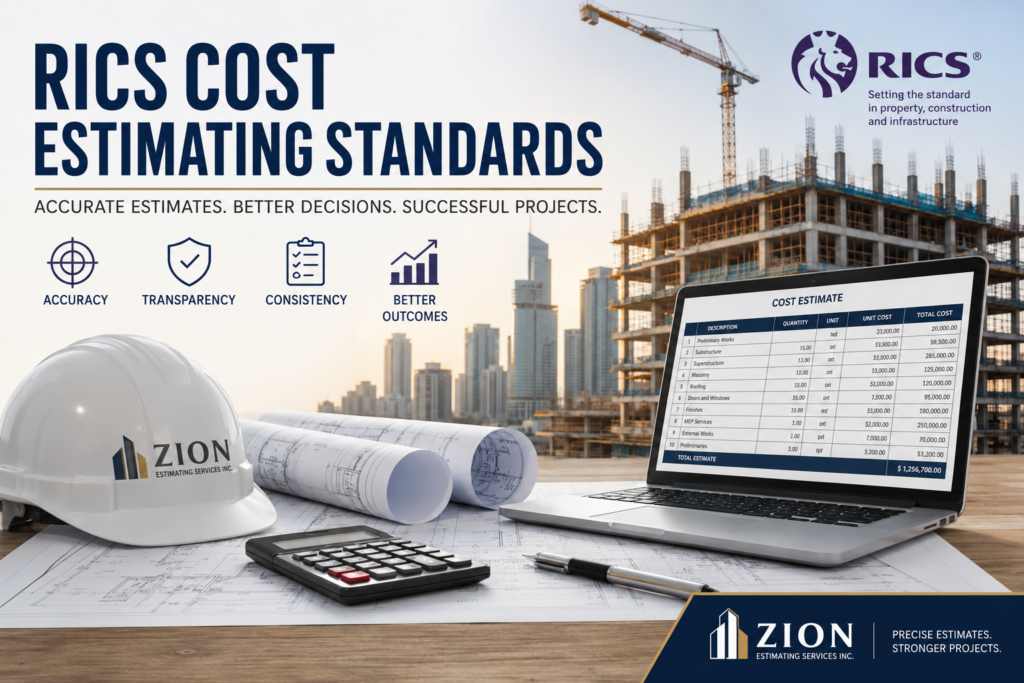
Learn how RICS Cost Estimating Standards improve construction cost accuracy, budgeting, and project success with Zion Estimating Services Inc.
RICS Cost Estimating Standards: The Complete Guide for Accurate Construction Cost Planning
Introduction
In today’s competitive construction industry, accurate cost estimation is more important than ever. Whether you’re planning a residential renovation, a commercial development, or a large-scale infrastructure project, a reliable estimate determines the success of your investment. One of the most respected frameworks for achieving cost certainty is the RICS Cost Estimating Standards.
At Zion Estimating Services Inc., we understand that contractors, developers, architects, lenders, and property owners require dependable cost estimates that reduce financial risks and improve project planning. By following internationally recognized estimating principles inspired by RICS methodologies, we help clients make informed decisions from project conception to completion.
This comprehensive guide explains what RICS Cost Estimating Standards are, why they matter, their benefits, and how professional estimating services contribute to successful construction projects.
What Are RICS Cost Estimating Standards?
RICS Cost Estimating Standards are professional guidelines developed by the Royal Institution of Chartered Surveyors to establish consistency, transparency, and accuracy in construction cost estimation.
These standards provide a structured methodology for:
- Preparing construction cost estimates
- Measuring project costs
- Managing project budgets
- Reporting financial information
- Cost planning throughout the project lifecycle
- Maintaining transparency between stakeholders
Rather than relying on assumptions, RICS standards encourage evidence-based estimating using standardized measurement techniques and clear documentation.
Why Accurate Cost Estimation Matters
Every successful construction project begins with an accurate budget.
Poor estimating often leads to:
- Budget overruns
- Construction delays
- Financing problems
- Design revisions
- Contractor disputes
- Material shortages
- Reduced profitability
Professional estimators following recognized standards minimize these risks by delivering reliable financial forecasts before construction begins.
Core Principles of RICS Cost Estimating Standards
1. Accuracy
Every estimate should reflect realistic market conditions, current material pricing, labor costs, equipment expenses, and project complexity.
Accurate estimates reduce uncertainty and help stakeholders plan effectively.
2. Consistency
Using standardized methods ensures different estimators produce comparable results for similar projects.
Consistency improves communication among owners, contractors, architects, and lenders.
3. Transparency
Every cost should be traceable.
Professional estimates clearly explain:
- Material quantities
- Labor assumptions
- Equipment costs
- Markups
- Overheads
- Contingencies
This transparency reduces misunderstandings during construction.
4. Documentation
RICS standards emphasize maintaining complete documentation for every estimate.
Proper documentation includes:
- Drawings reviewed
- Specifications
- Quantity takeoffs
- Pricing sources
- Assumptions
- Exclusions
- Risk allowances
5. Risk Assessment
Construction projects involve uncertainty.
Professional estimators identify risks such as:
- Material price fluctuations
- Labor shortages
- Design changes
- Market volatility
- Weather conditions
Including reasonable contingencies improves financial planning.
Stages of Cost Estimation
Professional estimating evolves throughout project development.
Concept Estimate
Prepared during early planning.
Purpose:
- Determine project feasibility
- Compare investment options
- Establish preliminary budgets
Accuracy Range:
±30%
Preliminary Estimate
Developed after schematic designs become available.
Includes:
- Basic building systems
- Preliminary quantities
- Market pricing
Accuracy Range:
±20%
Detailed Estimate
Prepared after design development.
Includes:
- Detailed quantity takeoffs
- Material specifications
- Labor calculations
- Equipment costs
Accuracy Range:
±10%
Tender Estimate
Prepared for competitive bidding.
Includes:
- Complete project scope
- Final specifications
- Bid-ready pricing
This estimate becomes the basis for contractor proposals.
Components of a Professional Cost Estimate
A comprehensive estimate generally includes:
Material Costs
Materials often represent the largest project expense.
Examples include:
- Concrete
- Steel
- Lumber
- Masonry
- Roofing
- Drywall
- Flooring
- Paint
- Plumbing fixtures
- HVAC equipment
Labor Costs
Labor estimates account for:
- Skilled trades
- General labor
- Productivity rates
- Overtime
- Regional wage differences
Equipment Costs
Construction equipment may include:
- Excavators
- Cranes
- Loaders
- Forklifts
- Concrete pumps
- Scaffolding
Subcontractor Costs
Many specialized trades require subcontractors.
Examples:
- Electrical
- Plumbing
- Fire protection
- HVAC
- Elevators
- Landscaping
General Conditions
These include:
- Temporary facilities
- Site supervision
- Safety management
- Site utilities
- Project administration
Overhead and Profit
Professional estimates include reasonable contractor overhead and profit margins.
Contingencies
Contingency allowances help cover unforeseen conditions during construction.
Benefits of Following RICS Cost Estimating Standards
Improved Budget Accuracy
Accurate estimating minimizes unexpected expenses during construction.
Better Investment Decisions
Developers can confidently evaluate project feasibility before committing capital.
Reduced Financial Risk
Reliable estimates reduce the likelihood of budget overruns.
Improved Tender Comparisons
Standardized estimates allow fair contractor comparisons.
Greater Client Confidence
Transparent estimating builds trust between clients and construction professionals.
Better Project Control
Accurate budgets improve cost monitoring throughout construction.
Industries That Benefit from RICS Standards
Professional estimating benefits nearly every construction sector.
Residential Construction
Including:
- Custom homes
- Apartment buildings
- Townhouses
- Renovations
Commercial Construction
Projects include:
- Office buildings
- Retail centers
- Hotels
- Restaurants
Healthcare
Hospitals
Medical offices
Clinics
Laboratories
Educational Facilities
Schools
Universities
Training centers
Industrial Projects
Factories
Warehouses
Distribution centers
Manufacturing plants
Government Projects
Municipal buildings
Public infrastructure
Transportation facilities
Emergency services
Modern Estimating Technology
Today’s estimators combine professional expertise with advanced software.
Popular estimating platforms include:
- Bluebeam Revu
- PlanSwift
- On-Screen Takeoff
- Trimble Estimation
- CostX
- eTakeoff
These tools improve:
- Quantity takeoffs
- Accuracy
- Productivity
- Digital collaboration
However, software is only as effective as the estimator using it.
Common Estimating Mistakes
Avoiding these errors improves project outcomes.
Incomplete Drawings
Missing information leads to inaccurate quantities.
Ignoring Market Conditions
Material prices change frequently.
Professional estimators monitor current market trends.
Underestimating Labor
Labor productivity varies by location, weather, and project complexity.
Missing Scope Items
Small omissions can become expensive change orders.
Unrealistic Contingencies
Too little contingency increases financial risk.
Why Choose Zion Estimating Services Inc.
At Zion Estimating Services Inc., we provide comprehensive construction estimating solutions for contractors, developers, architects, engineers, and property owners throughout the United States.
Our services include:
- Residential estimating
- Commercial estimating
- Quantity takeoffs
- Material takeoffs
- Bid preparation
- Cost planning
- Budget estimating
- CSI Division estimates
- Value engineering support
- Pre-construction estimating
Our experienced estimators use modern estimating software and industry best practices to deliver dependable cost estimates that help clients win bids and control construction costs.
Whether you’re bidding on a single-family home or a multi-million-dollar commercial development, we deliver estimates that support informed decision-making and project success.
Best Practices for Cost Estimation
To maximize estimating accuracy:
- Begin estimating early in project planning.
- Update estimates as designs evolve.
- Review current material pricing regularly.
- Document all assumptions and exclusions.
- Include realistic contingency allowances.
- Perform independent estimate reviews.
- Use experienced construction estimators.
- Maintain clear communication among stakeholders.
These practices align with internationally recognized estimating methodologies and improve overall project performance.
Frequently Asked Questions
What are RICS Cost Estimating Standards?
They are internationally recognized professional guidelines that promote consistency, transparency, and accuracy in construction cost estimation and cost planning.
Who uses RICS Cost Estimating Standards?
Quantity surveyors, contractors, developers, architects, engineers, lenders, government agencies, and project managers commonly rely on these standards.
Why are standardized estimating methods important?
Standardized methods reduce errors, improve communication, support better budgeting, and make project costs easier to compare and manage.
Can RICS standards help reduce cost overruns?
Yes. By using structured estimating processes, detailed documentation, and risk assessment, projects are less likely to experience unexpected budget increases.
Does Zion Estimating Services Inc. provide estimates for all CSI divisions?
Yes. We provide comprehensive estimating and quantity takeoff services covering all CSI divisions for residential, commercial, and industrial construction projects across the United States.
Conclusion
Accurate construction estimating is the foundation of every successful project. By following the principles behind RICS Cost Estimating Standards, project teams can improve budgeting accuracy, strengthen financial planning, reduce project risks, and build greater confidence among all stakeholders.
At Zion Estimating Services Inc., we are committed to delivering precise, transparent, and professional estimating services that help our clients achieve better project outcomes. Whether you need a conceptual budget, a detailed quantity takeoff, or a complete bid estimate, our experienced team is ready to support your next construction project with dependable cost estimating solutions.
Contact Zion Estimating Services Inc. today to discuss your next project and discover how expert cost estimating can save time, reduce risk, and improve profitability.
Contact Information for Zion Estimating:
- Phone Number: 718-427-9941
- Email Address: [email protected]
- Website: https://zionestimating.com